Discover how rapid microsecond disconnects, programmable restoration delays, and continuous monitoring keep expensive home electronics safe from disastrous utility fluctuations.
Michael Johnson
•
September 5, 2026
•
6 min read
•
Switchboard Hardware
The Unseen Threat of Grid Voltage Swings
Most homeowners mistakenly assume that standard miniature circuit breakers in their distribution panel protect against all electrical anomalies. Circuit breakers act strictly as overcurrent and short-circuit interruptors. They remain completely blind when utility voltage surges to 300V or plummets below 160V, allowing harmful electrical pressure to reach every plugged device across the household.
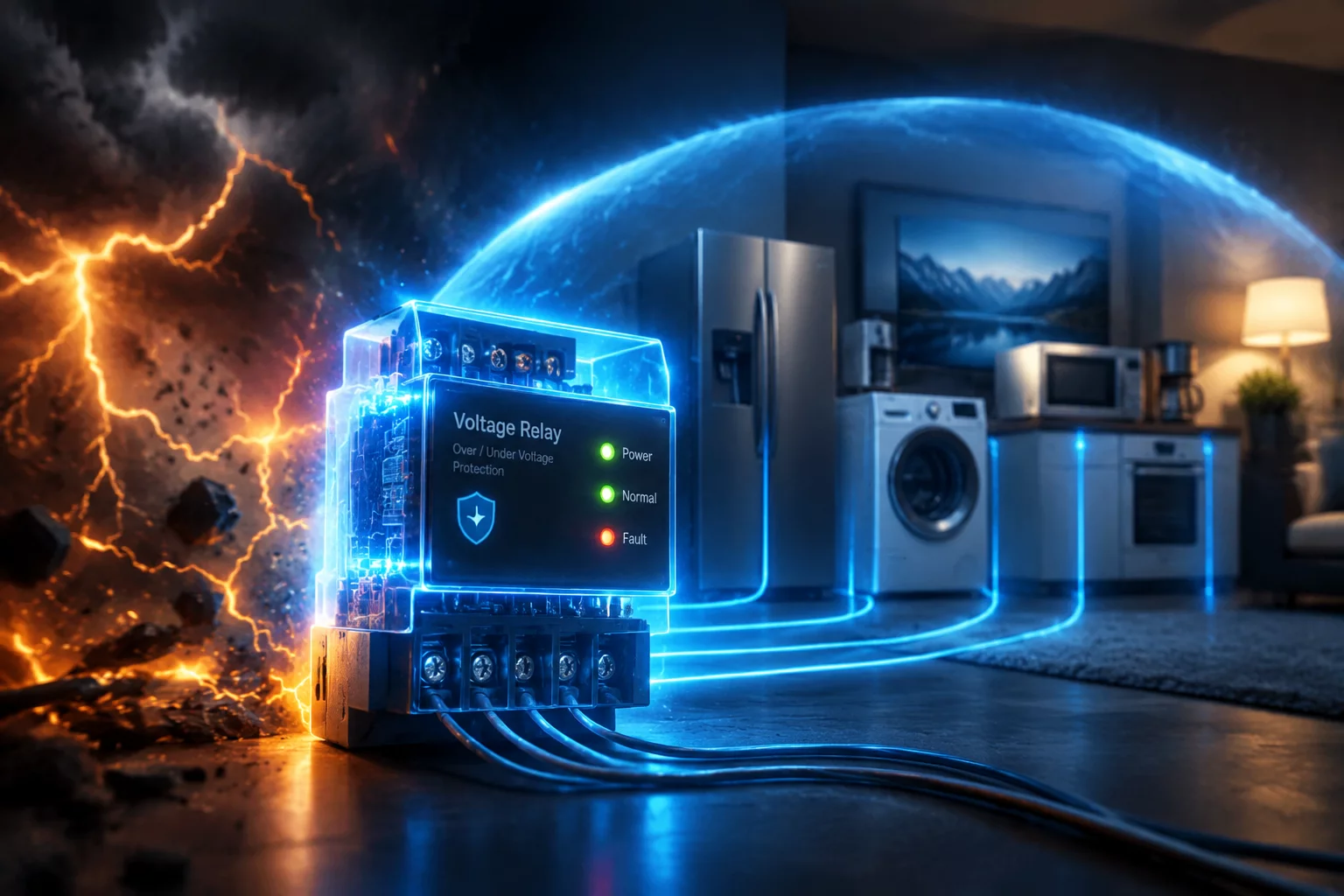
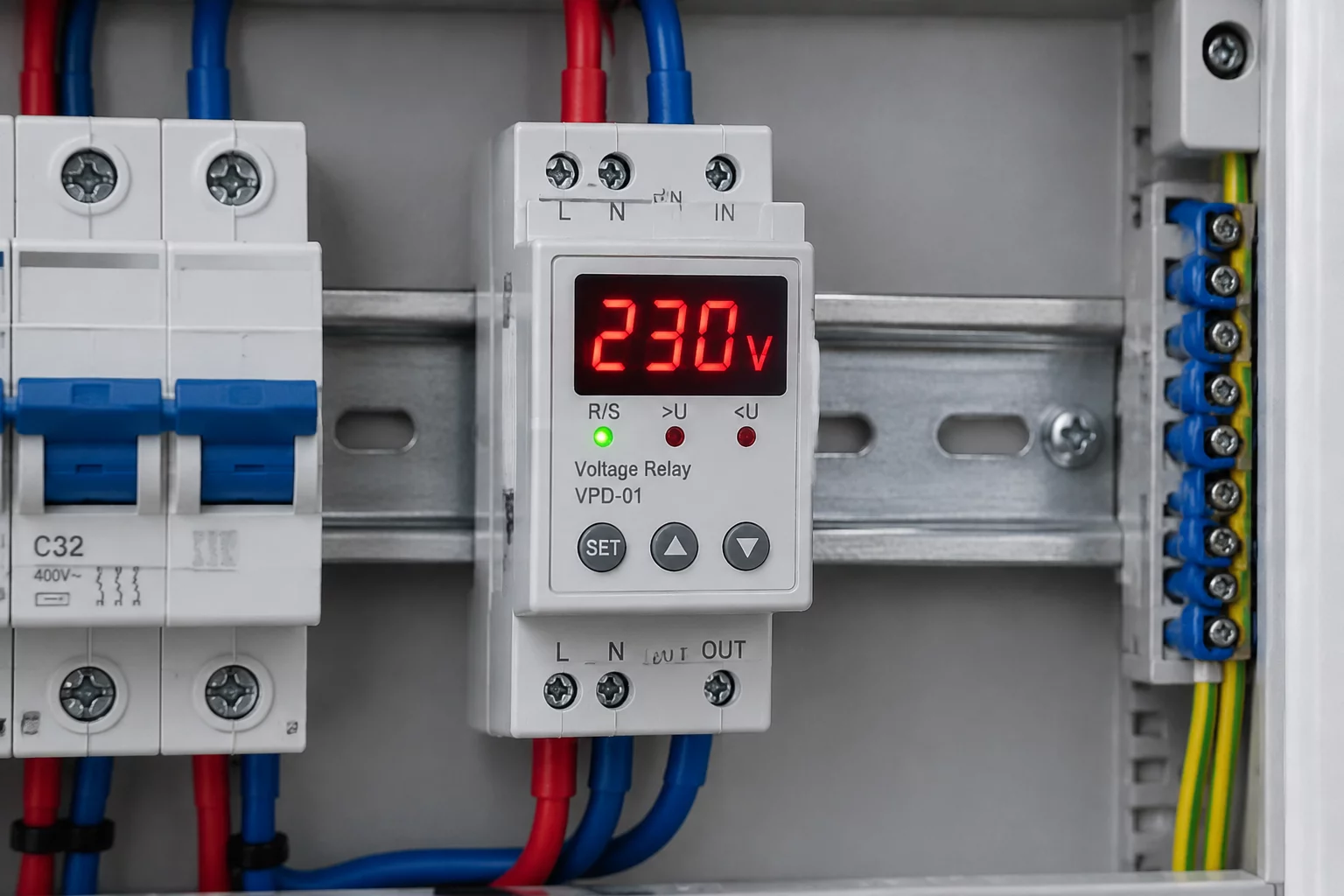
Modern appliances rely on sensitive digital control microcontrollers, switch-mode power converters, and brushless inverter compressors. When incoming voltage exceeds safe operational bounds, internal semiconductor layers break down, electrolytic capacitors burst, and compressor stator windings burn out within fractions of a second. Installing a dedicated DIN-rail voltage relay solves this danger by continuously sampling line voltage and severing output connections the moment parameters stray outside user-defined boundaries.
Comprehensive Grid Defense
Safeguard Your Consumer Unit Today
Explore coordinated whole-home protection packages featuring digital voltage monitoring relays and heavy-duty surge arresters.
Household electronic appliances conform to strict nominal operational ranges. Deviations exceeding acceptable margins generate excessive thermal stress and insulation dielectric breakdown. The comparison below illustrates typical power grid failure states and the protection threshold executed by an automatic voltage relay:
Grid Failure Condition
Observed Deviation
Equipment Vulnerability & Risk
Neutral Conductor Rupture
Surge up to 340V–380V
Instant destruction of power boards
Local Line Sag (Brownout)
Drop below 170V AC
Motor stalling & thermal burnout
Substation Switching Swings
260V–290V sustained spikes
Capacitor swelling and life reduction
Relay Disconnect Speed
0.02 – 0.05 seconds
Total circuit isolation in milliseconds
Everyday Scenarios Where Relays Save Equipment
Catastrophic damage rarely stems from atmospheric lightning strikes alone. Routine infrastructure wear and unbalanced phase distribution cause persistent destructive anomalies in both suburban dwellings and urban high-rises:
Neutral wire severance inside shared distribution lines, sending unbalanced 380V phase voltage into single-phase household sockets and instantly combusting active electronics.
Neighborhood-wide winter heating or summer air conditioning surges causing deep line brownouts, starving refrigerator and heat pump compressors of starting torque until motor coils fry.
Rapid multiple re-energizations by utility automated reclosers, which bombard power supplies with chaotic voltage pulses before internal circuits can properly discharge.
A calibrated voltage relay completely neutralizes these threats. The internal microprocessor checks true RMS voltage hundreds of times per second. As soon as readings breach permissible safety parameters, an electromagnetic contactor disconnects power within twenty milliseconds, leaving all connected loads securely decoupled.
Optimal Threshold Configurations and Installation
Proper relay operation depends directly on sensible trip parameters. For standard residential 230V systems, set the upper cutoff threshold between 250V and 255V, and the lower threshold between 185V and 190V. Setting bounds too tightly triggers nuisance trippings during harmless momentary loads, while excessively generous bands permit prolonged stress on internal power supply filter capacitors.
Another pivotal parameter is the reconnect delay timer. Inductive equipment such as refrigerators, dehumidifiers, and heat pumps require equalized refrigerant gas pressure before restarting. Set the reconnection delay between 180 and 300 seconds to protect compressor motor mechanisms against high starting mechanical resistance following an emergency trip.
Michael Johnson
Senior Electrical Systems Engineer
Michael has over 14 years of hands-on experience designing consumer switchboards, transient voltage suppressors, and power quality conditioning systems for high-reliability residential applications.
Last spring a street transformer neutral lug burnt through on our line. Several neighbors had their TV power boards and washing machine controls destroyed. My 63A relay cut the incoming feed in milliseconds and kept every room safe until the utility crew finished repairs.
Michael JohnsonAuthor
08/29/2026
@David Vance That is textbook neutral displacement. Without an active relay tripping on overvoltage, a 3-phase split shifts up to 380V directly through phase-to-neutral appliances. Glad your switchboard had the right defense in place!
Sarah JenkinsLicensed Electrician
09/01/2026
@Michael Johnson Excellent point on the reconnect delay timer. Many clients initially complain about a 4-minute reboot wait after an outage, but once you explain how compressor head pressures work, they understand the value immediately.
Leave a Comment
Share your engineering insights or inquire about surge defense architectures.

Reader Discussion
Last spring a street transformer neutral lug burnt through on our line. Several neighbors had their TV power boards and washing machine controls destroyed. My 63A relay cut the incoming feed in milliseconds and kept every room safe until the utility crew finished repairs.
Leave a Comment
Share your engineering insights or inquire about surge defense architectures.